

Product · 02
Medical SOAPSubjective. Objective. Assessment. Plan.
AI agents prepare. Clinicians decide. Every note is audit-clean.
Structured clinical documentation prepared by the agent and reviewed by the clinician — the SOAP record stays consistent across departments, languages, and care teams, with full audit history.
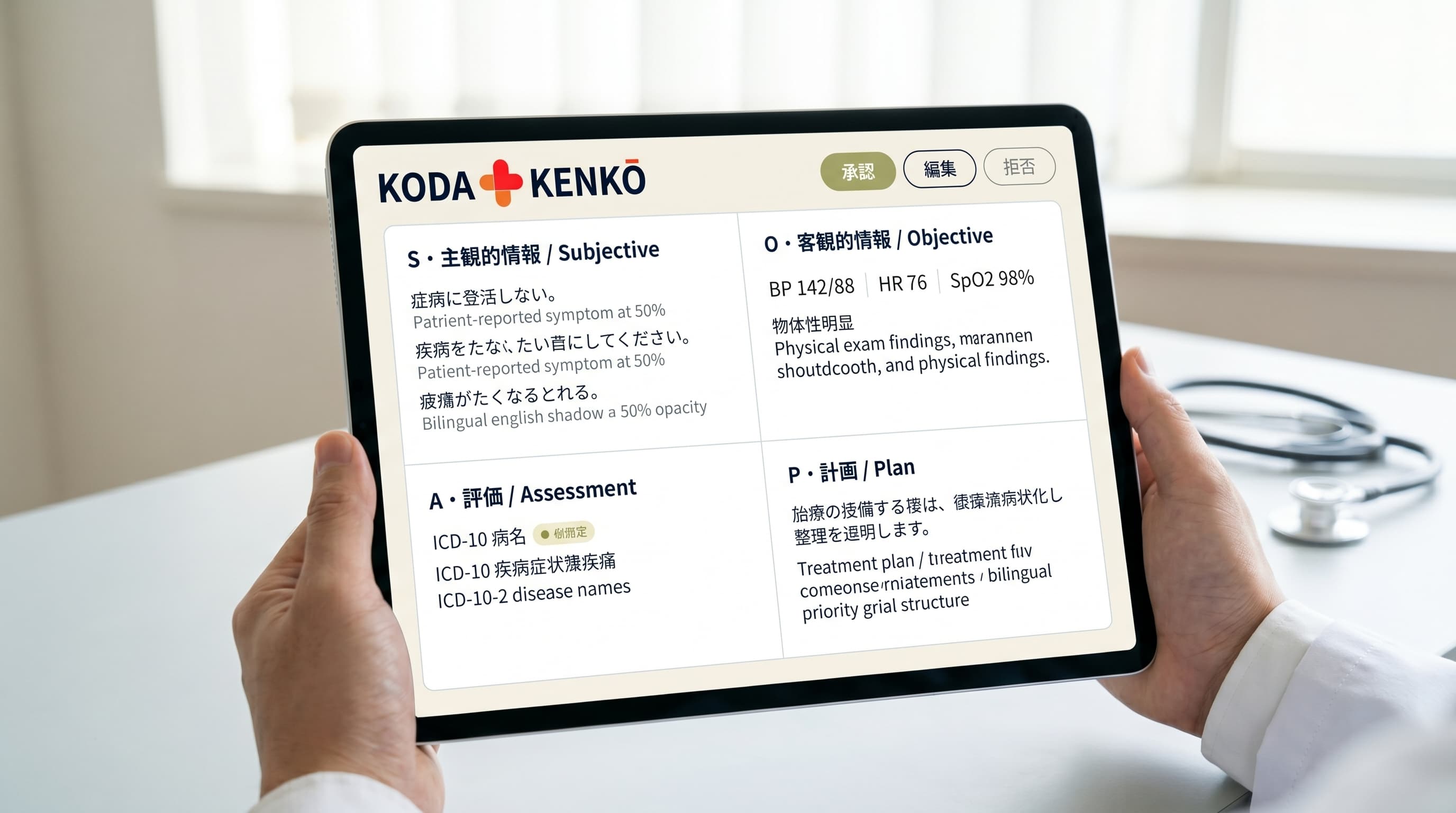
Bilingual by default
English and Japanese, side by side.
Every field, every label, every clinical note — the SOAP record is bilingual by default so the same artefact reads cleanly to Japanese clinicians and international reviewers.
Subjective / 主観的情報. Objective / 客観的情報. Assessment / 評価. Plan / 計画. The bilingual structure is not an afterthought translation — it is the canonical form of the record, validated at input, preserved through review, exportable to any downstream system.
Dictation handles Kansai, Tōhoku, Kyūshū, and Hokkaido regional speech patterns. Multi-language intake in English, Portuguese, Chinese, Vietnamese, Tagalog, Nepali, and other major Asian languages — documented in Japanese for the clinical record so the foreign-patient encounter enters the same operational record as every other encounter.
ICD-10 carries the canonical Japanese 病名 vocabulary — every SOAP artefact exports cleanly to JAHIS-aligned downstream systems, レセコン billing, and public-health registries without manual recoding.
Form factor
One product. Three form factors.
The same SOAP record on desktop at the workstation, on tablet at the bedside, and on mobile in the corridor — designed for the way clinicians actually move between rooms.
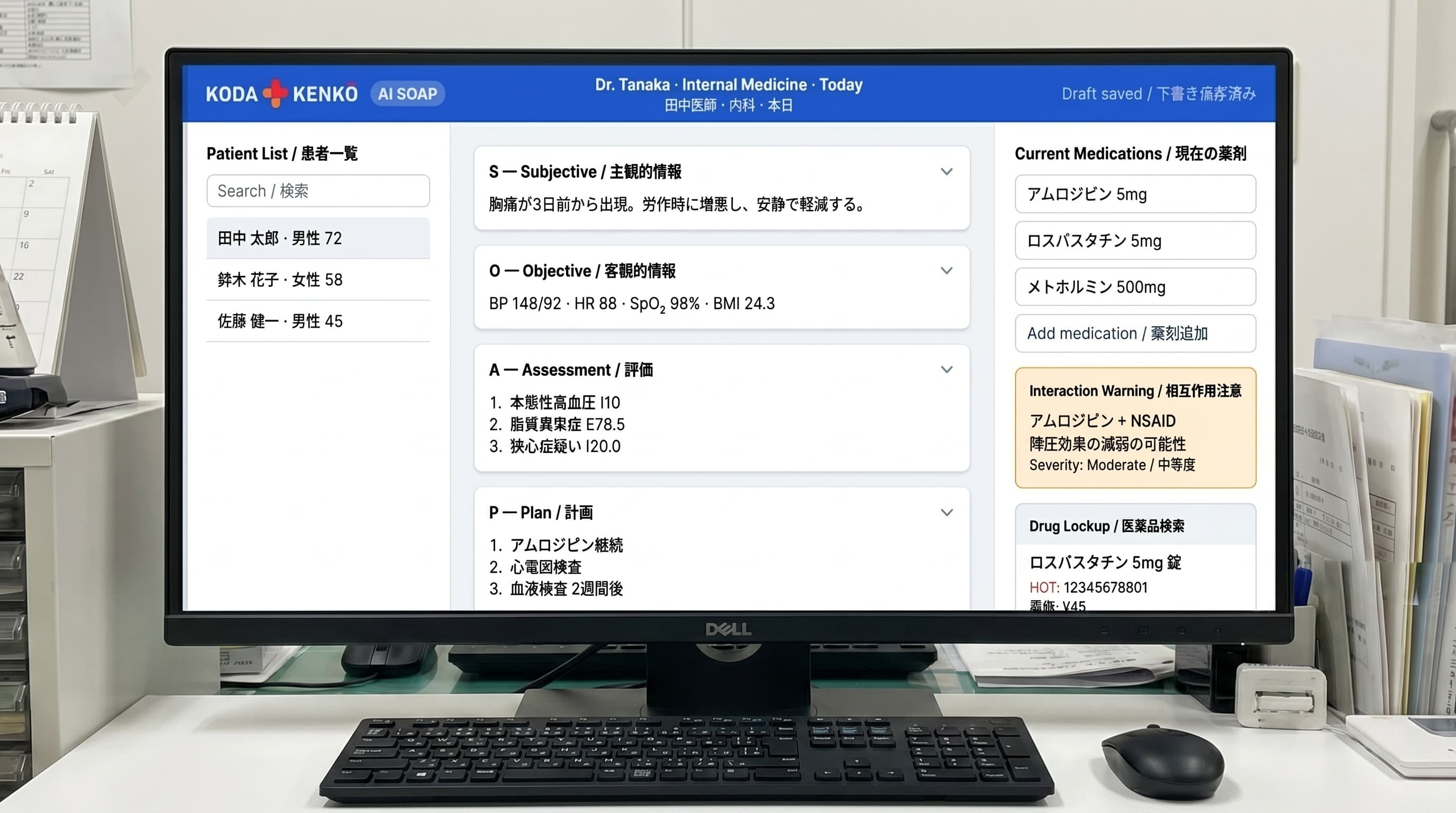
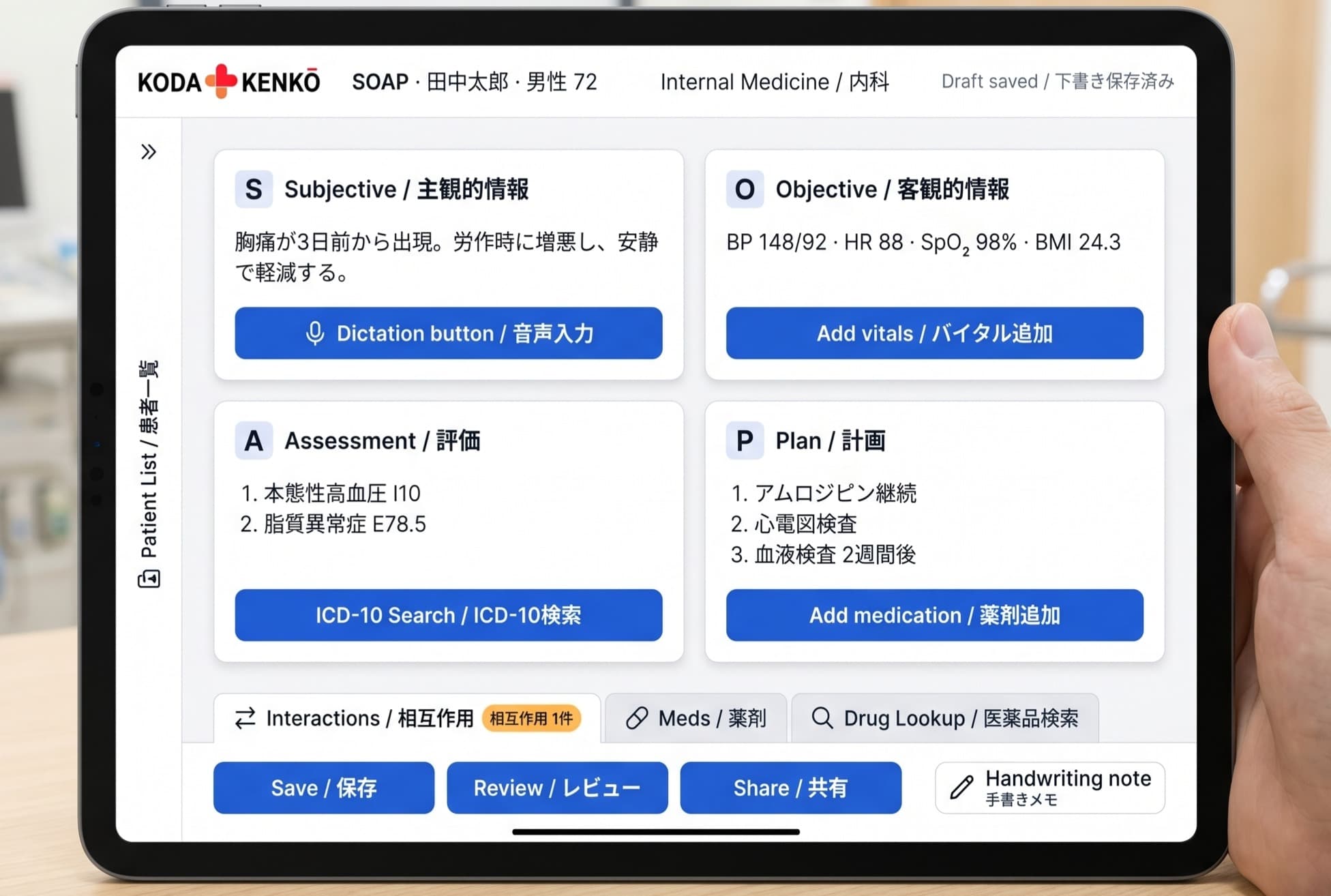
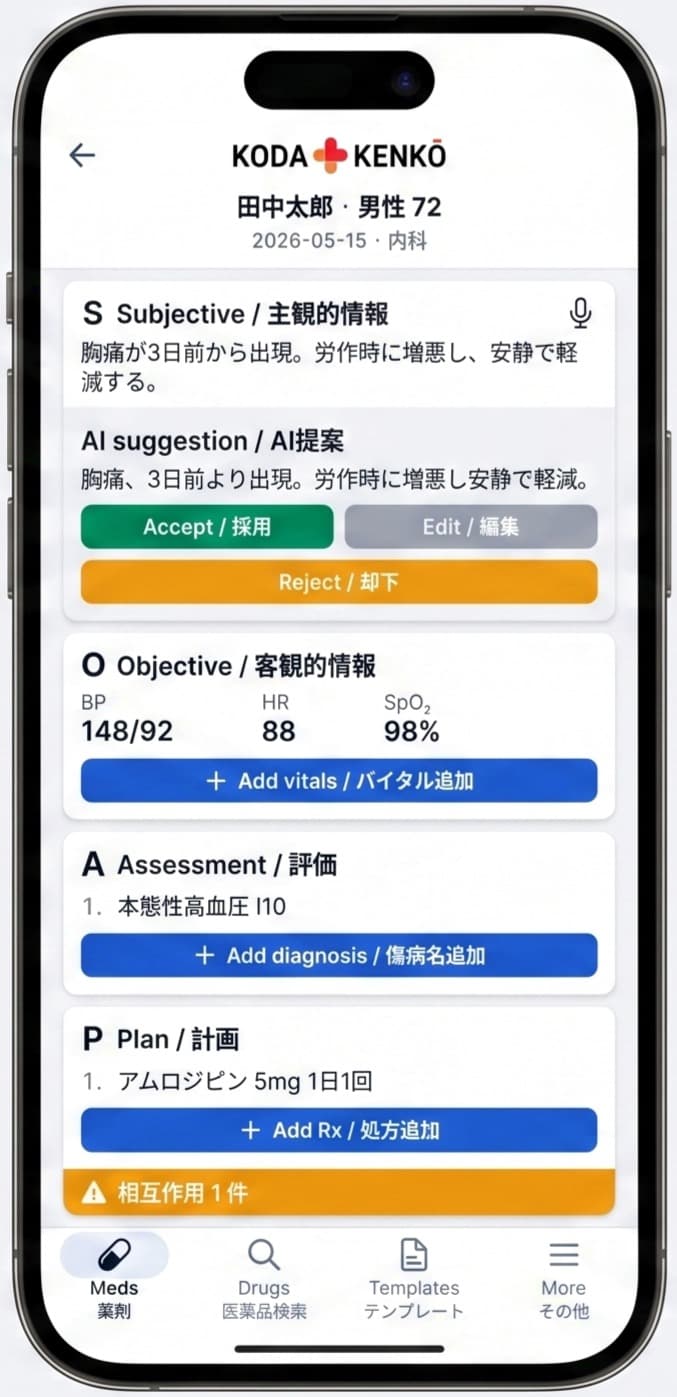
The clinician chooses the device. The platform stays the same.
Human-reviewed
AI agents draft. Clinicians decide.
The mobile interface above shows the explicit human-review boundary: an AI Suggestion panel produces a structured draft of the SOAP narrative; the clinician sees it as a suggestion, not a fait accompli. Accept commits the draft to the record. Edit opens the draft for clinical revision. Reject discards it entirely. Every decision is logged in the audit trail.
The platform never finalises a clinical artefact without that review step. The AI suggestion is a tool the clinician picks up or sets down — it is never the record itself.
Medical SOAP · KODA KENKŌ
See SOAP in your environment.
A 15-minute walkthrough with KodaSōken engineering. We open the SOAP product, draft a clinical note end-to-end, and answer integration questions in real time.