

Product · 05
PharmacologyHOT-code-native. Pharmacist-reviewed.
AI agents cross-reference. Pharmacists decide. Every prescription is reviewed.
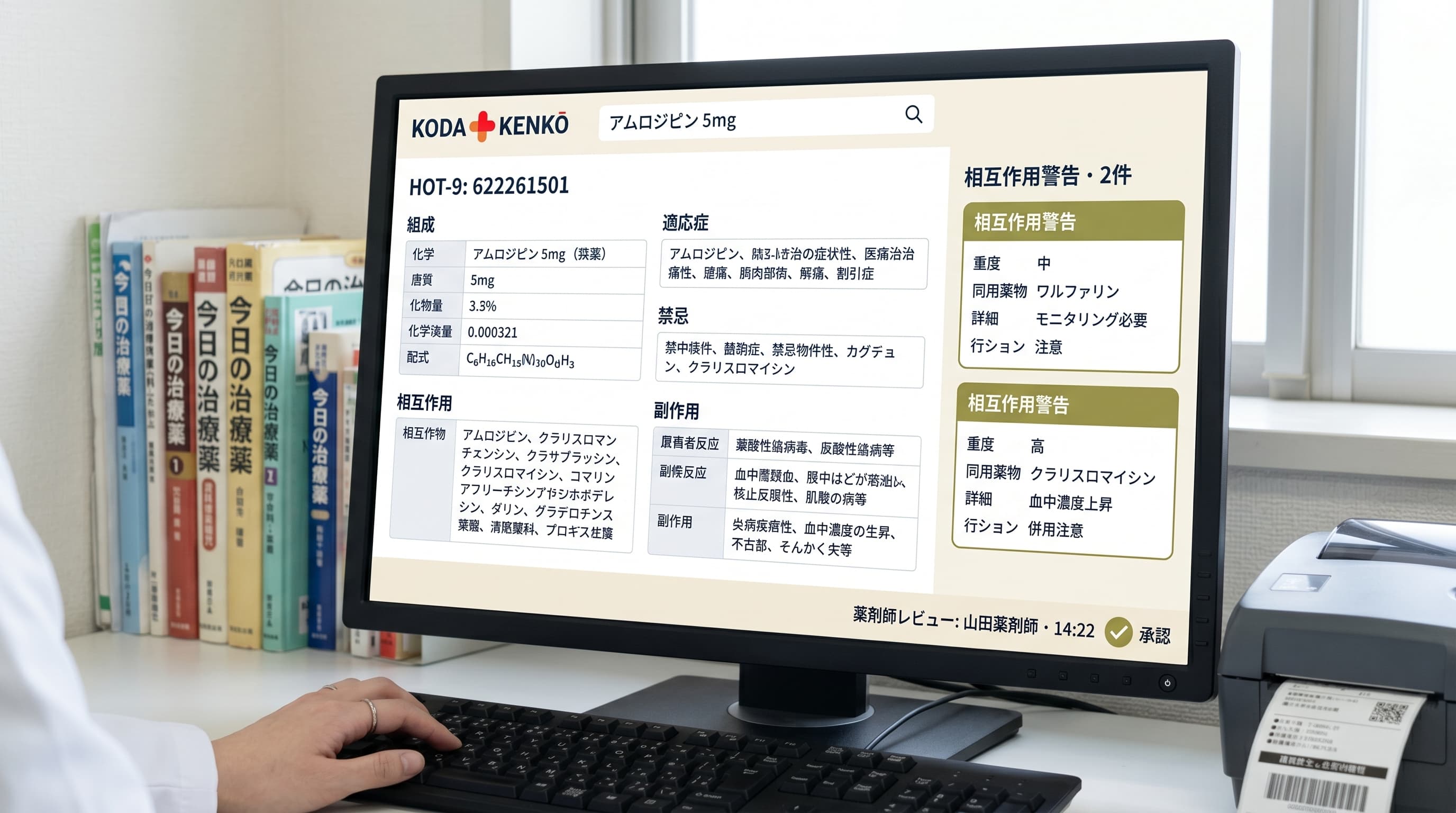
医薬品カタログ. Japanese HOT-code-native drug master — composition, dosage forms, indications, contraindications, and interactions — surfaced to pharmacists and clinicians for review and approval before any prescription is finalised. Cross-border medication reference for the foreign-patient flow most clinics still handle manually.
Who it is for
For the pharmacists, clinicians, and care teams who run prescription decisions every day.
Hospital pharmacies, dispensing clinics, university teaching hospitals, multilingual care networks, and home-care teams that handle medication continuity across language and geography.
Hospital pharmacies
Hospital and university-hospital pharmacy teams running the formulary, the interaction checks, and the pharmacist-review gate at scale. Audit-clean, JAHIS-aligned records on the same platform the clinical teams use.
Dispensing clinics & specialist practices
Clinics with in-house dispensing or close pharmacy partnerships. Pharmacology operates alongside SOAP and Medical Clerk so the prescription, the diagnosis, and the claim live on one record.
Multilingual & cross-border care
Foreign-patient clinics, embassy clinics, international medical schools, and home-care teams handling returning migrants or international patients. Cross-border medication reference surfaces Japanese equivalents for foreign meds and vice versa.
Workflows supported
Four workflows. One audit-clean medication record.
Every workflow is human-reviewed and logged in the audit trail.
Drug lookup & reference
Japanese HOT-code-native medication master — name, composition, dosage forms, indications, contraindications, administration routes. Drawn from Japanese pharmacology references, not adapted from foreign formularies.
Interaction checking
Drug-drug interactions surfaced at prescription preparation — severity, mechanism, clinical action. The pharmacist sees the same interaction panel the clinician sees, on the same record.
Contraindication alerts
Patient-specific contraindications — allergies, pregnancy, renal/hepatic function, age, comorbidities — flagged against the proposed prescription and surfaced for pharmacist review.
Cross-border medication reference
Foreign-patient continuity across Japanese, Brazilian (ANVISA), and international formularies. A Japanese clinician checks a Brazilian patient’s home meds; a Brazilian clinician checks the Japanese equivalent. Composition-equivalent lookup across formularies, not branded match.
Pharmacist review & approval
AI cross-references. The pharmacist decides. The clinician approves.
No prescription artefact is finalised without a human reviewer. The Pharmacology module surfaces an AI-prepared medication reference, interaction analysis, and contraindication check into the pharmacist queue. The pharmacist reviews, corrects if needed, and signs off — then the clinician finalises the prescription decision.
The reviewer is recorded. The timestamp is recorded. The content before and after the review is recorded. The approval is a load-bearing part of the workflow, not a checkbox.
The product does not prescribe. It does not dispense. It does not approve. It does the reference, interaction, and cross-border lookup work so the pharmacist can spend their time on the judgement calls that keep patients safe.
Integration & export
Reads what your team already runs. Writes back to the systems they trust.
Pharmacology reads from existing pharmacy management, dispensing, and EMR systems, and writes back through HL7 FHIR Medication resources and JAHIS-aligned exports. No parallel formulary. No migration project.
- HOT-code-native drug masterJapanese drug master built on HOT codes. Composition, dosage forms, indications, contraindications, interactions, administration routes — all linked to canonical Japanese drug identifiers.
- FHIR Medication resource exportPrescription records exportable as HL7 FHIR Medication, MedicationRequest, and MedicationStatement resources to existing EMR, pharmacy, and insurance systems.
- JAHIS-aligned audit exportPharmacist review records, approval timestamps, and content-before-after diffs exportable in JAHIS-aligned formats for institutional audit and regulatory review.
- Cross-border formulary referenceComposition-equivalent medication lookup across Japanese, Brazilian (ANVISA), and international formularies for the foreign-patient continuity use case.
- Deployment topologyCloud, on-premise, or hybrid. Edge support for clinics with intermittent connectivity.
Pharmacology · KODA KENKŌ
Bring your formulary.
We’ll bring the platform.
20-minute walkthrough with KodaSōken engineering. We open Pharmacology on one of your real prescription workflows and run it end-to-end. No deck.