

Medical AI infrastructurefor real healthcare work.
Six connected products. Less paperwork. Faster care. Built for governed clinical environments.
KODA KENKŌ helps healthcare teams reduce documentation time, support clinical workflows, and operate alongside existing EMR, reception, and hospital systems.
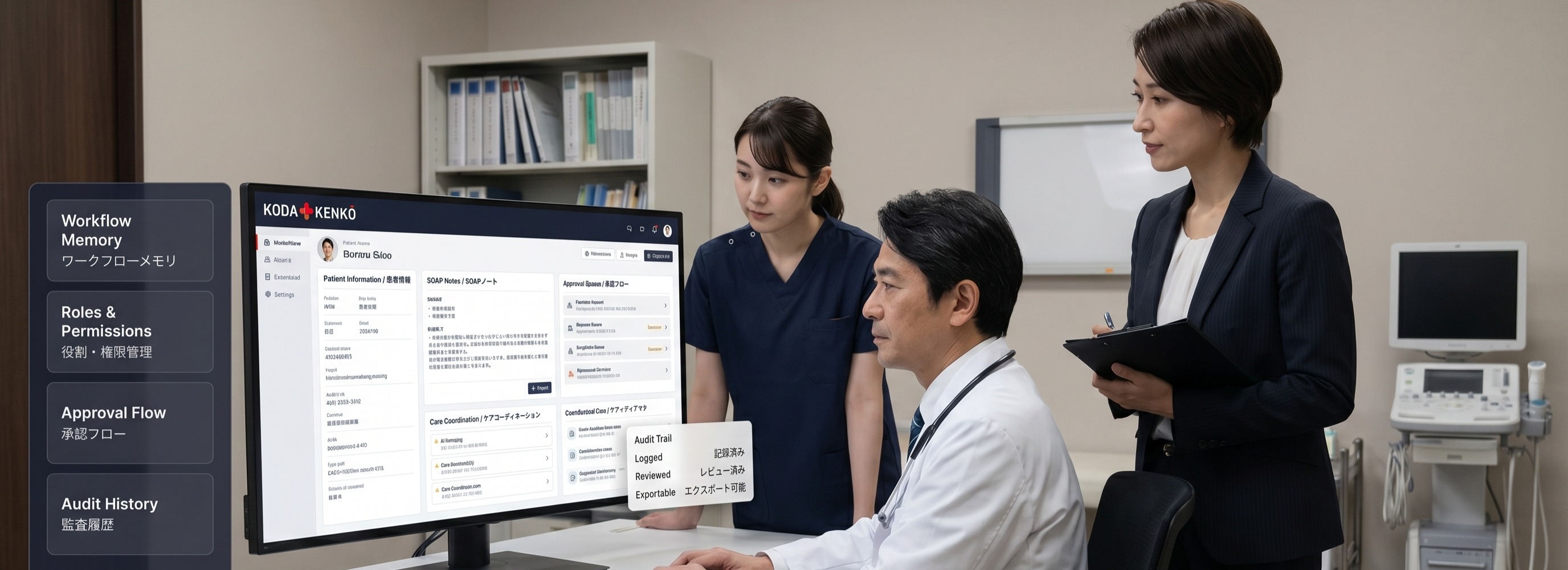
How it works
AI prepares.
Professionals review.
Teams move faster.
- 01
Collect
Voice, documents, intake forms, system feeds.
- 02
Organise
KoLo OS routes information into the right workflow context.
- 03
Draft
Purpose-built AI agents prepare structured drafts.
- 04
Verify
A second AI model checks the draft before it surfaces.
- 05
Review
The clinician, nurse, pharmacist, or clerk reviews and approves.
- 06
Record
The final artefact enters the operational record with full audit trail.
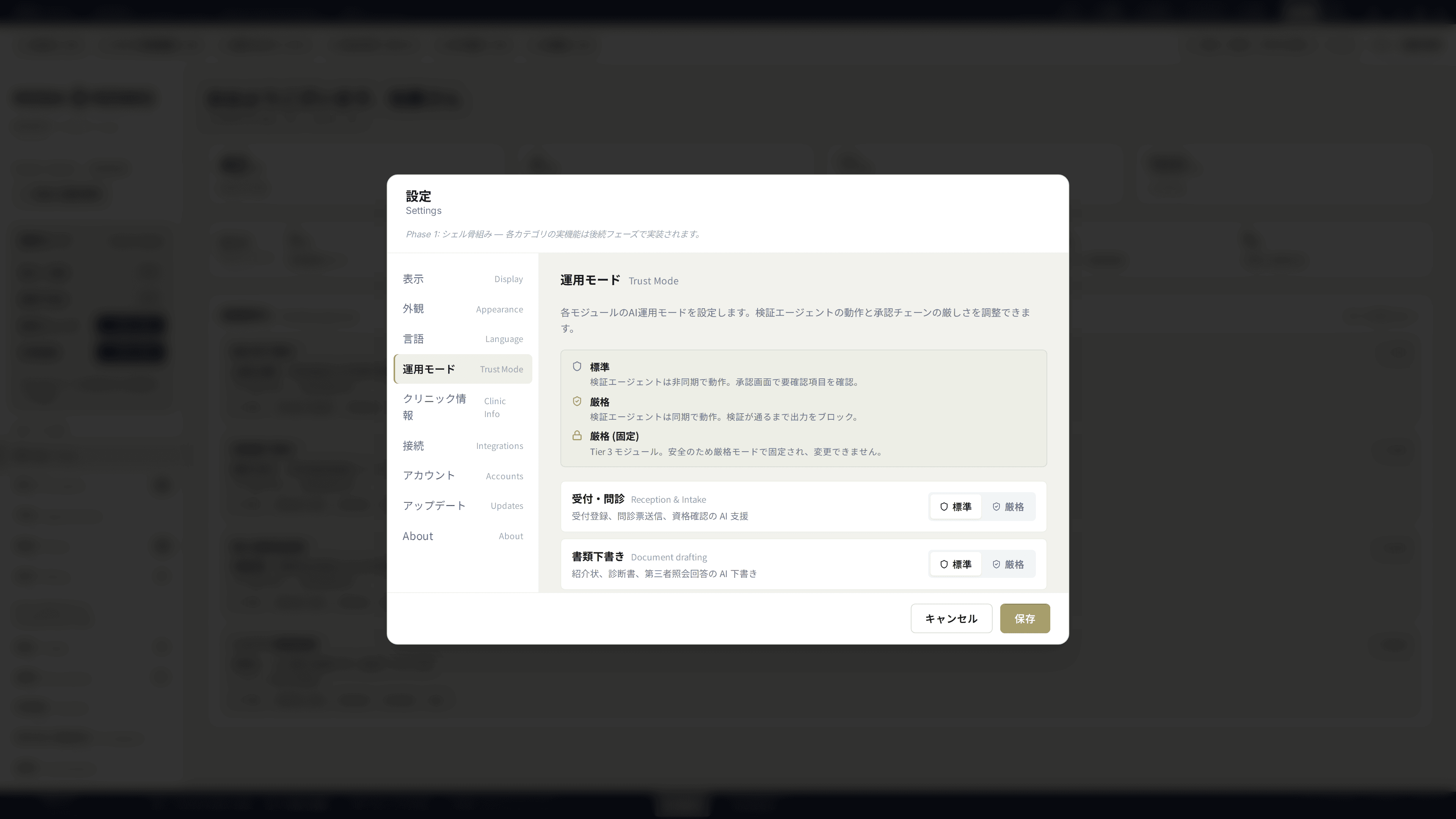
Every reviewer is recorded. Every timestamp is recorded.
Every change before and after approval is recorded.
The human is always in the loop — by design, not as an afterthought.
Integrates with
what is running.
KODA KENKŌ layers onto your existing EMR, or runs standalone.
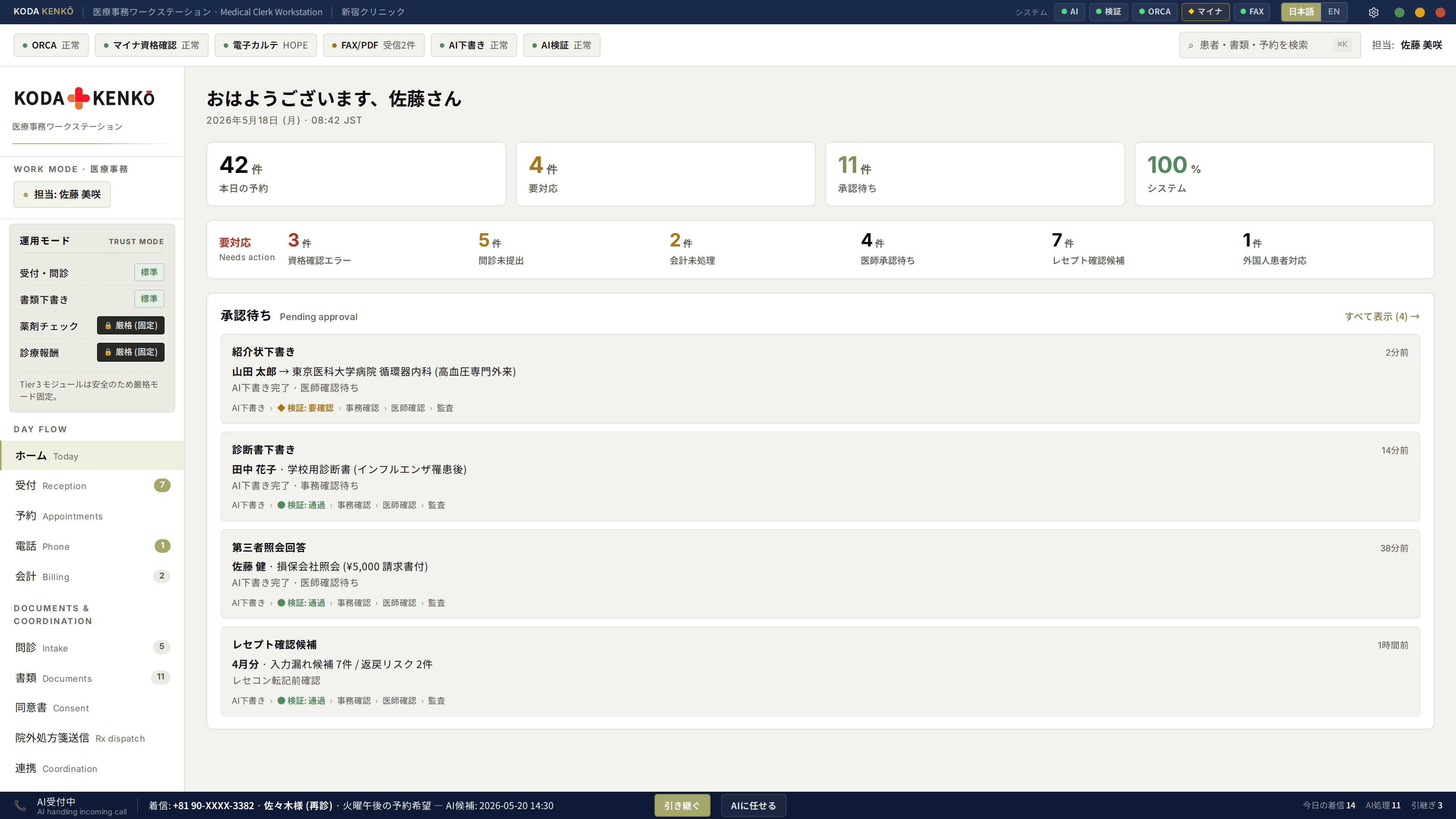
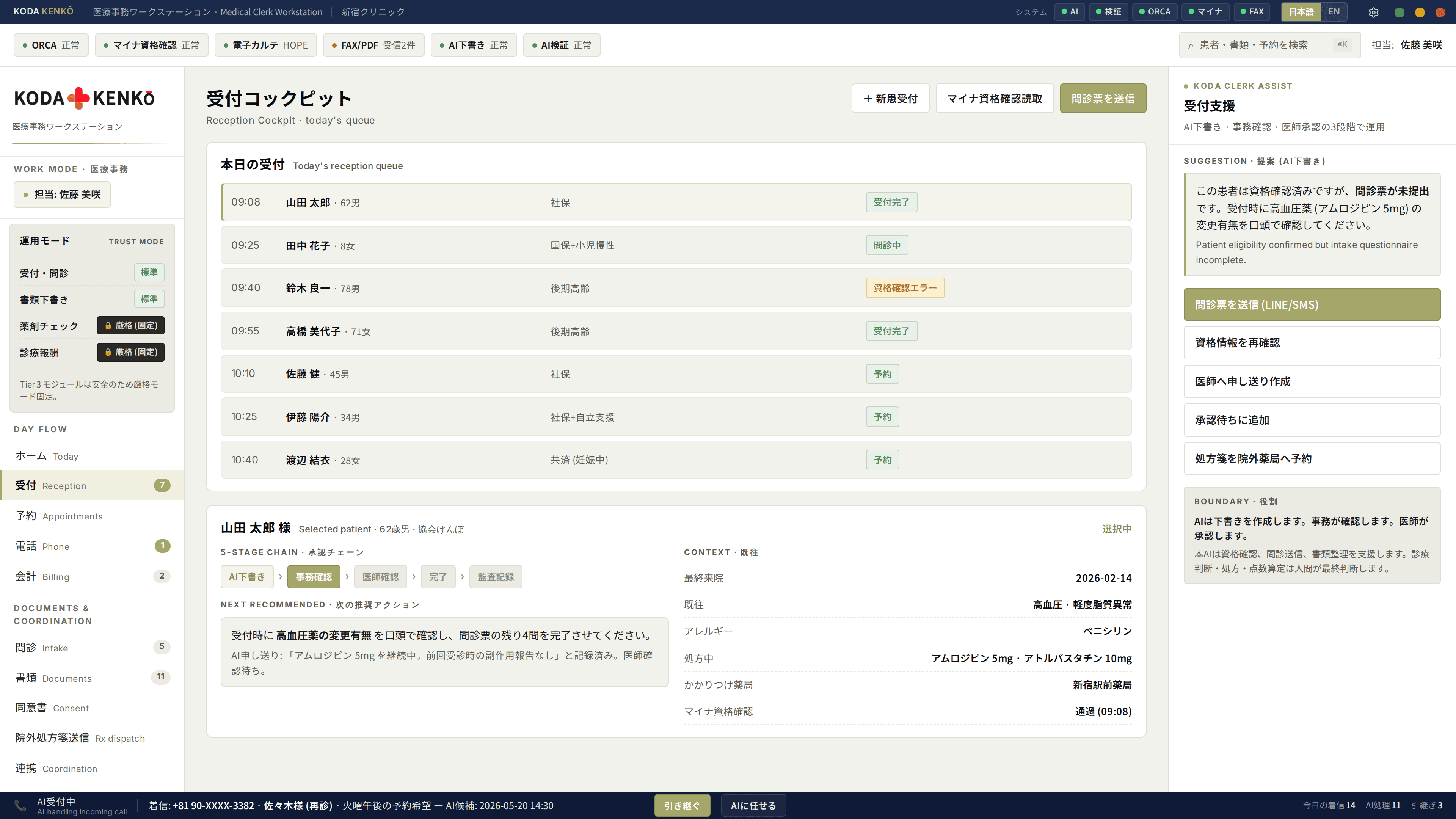
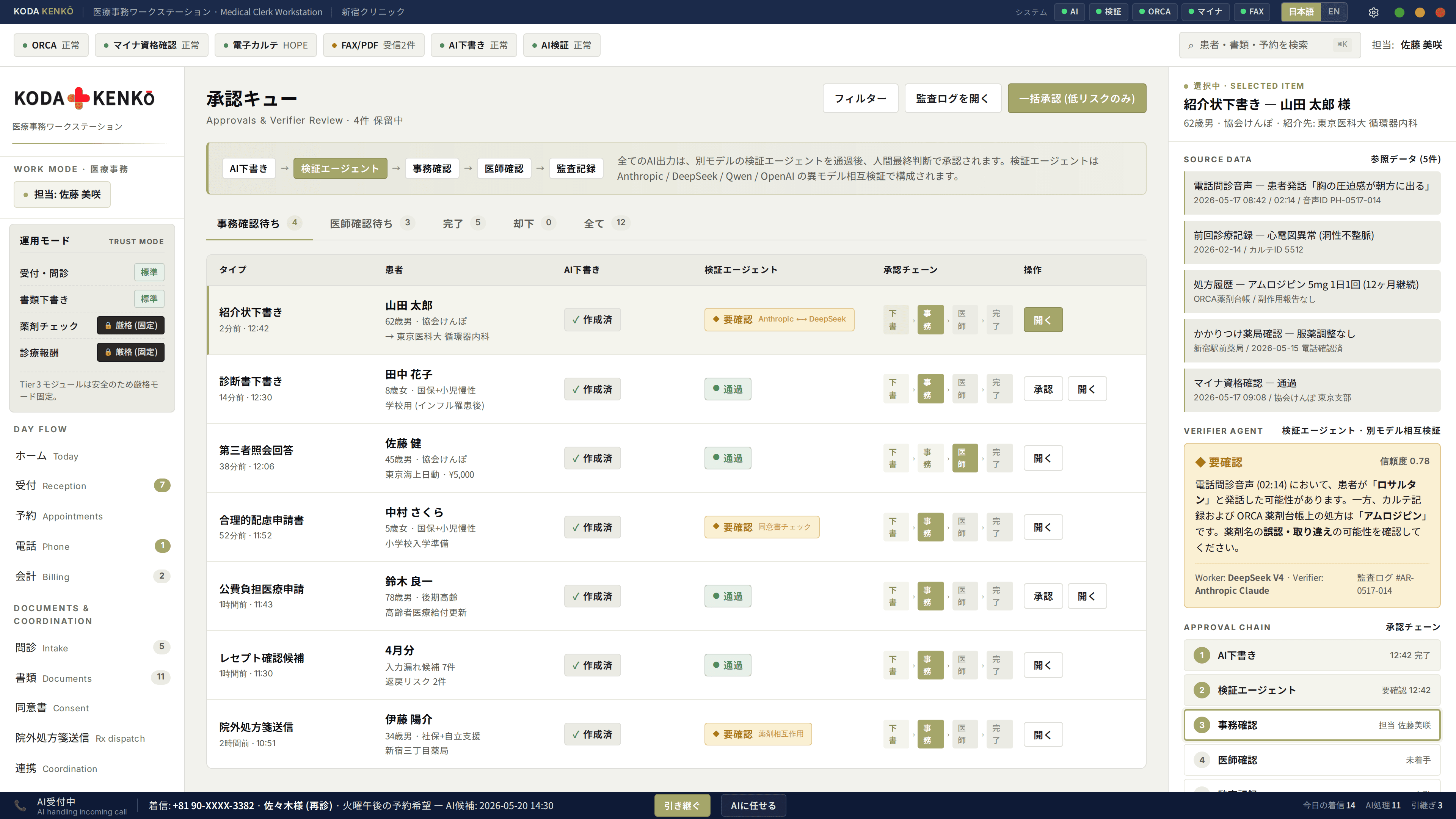
ホーム · Today operations cockpit
Operates above ORCA, Medicom-HRf, Dynamics, Fujitsu HOPE, NEC MegaOakHR, and major Japanese rezekon and EMR systems. No rip-and-replace.
Start with
what is needed first.
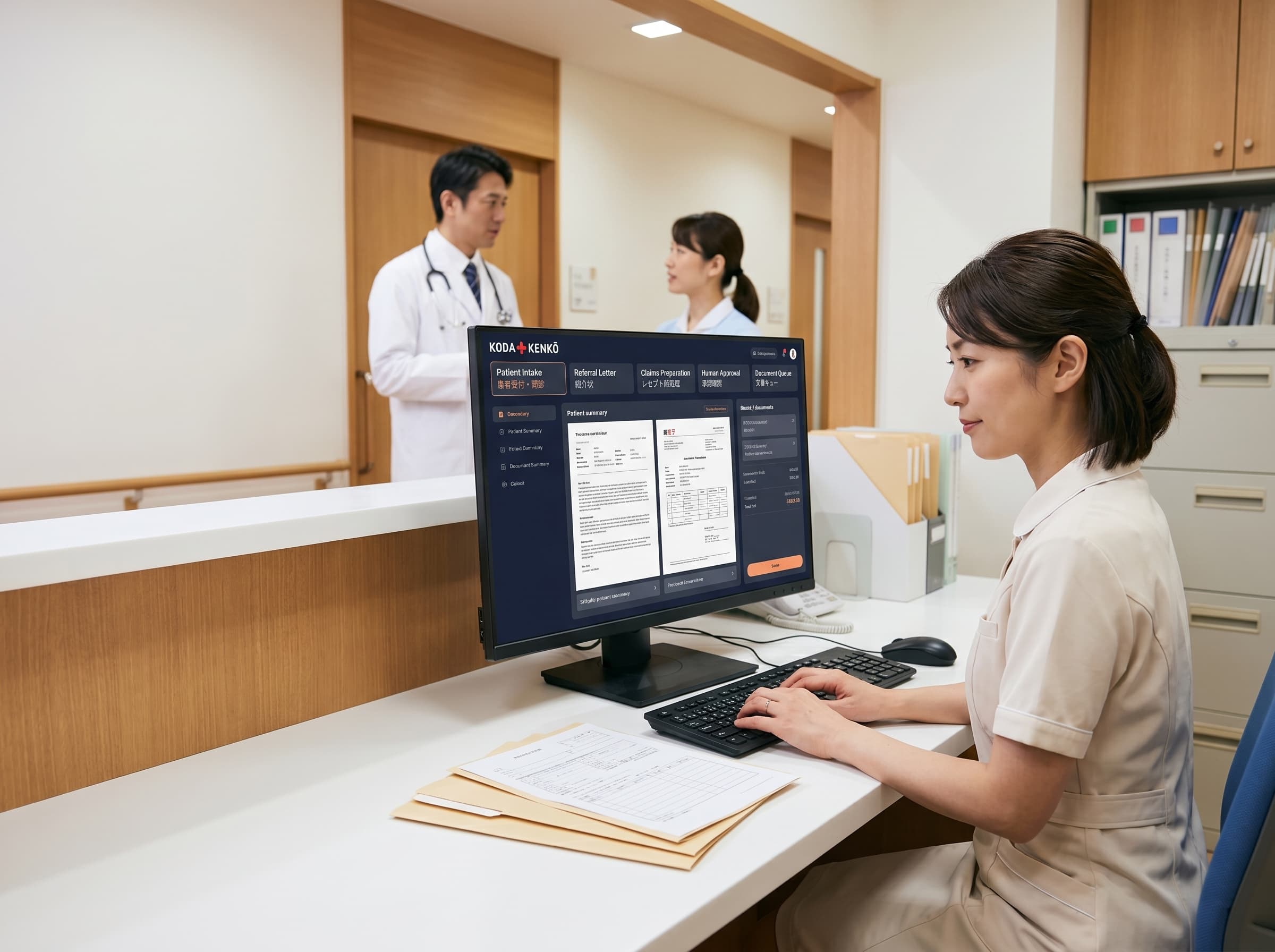
AI Medical Clerk
Intake, referrals, and claims — drafted by AI, approved by the clerk.
See product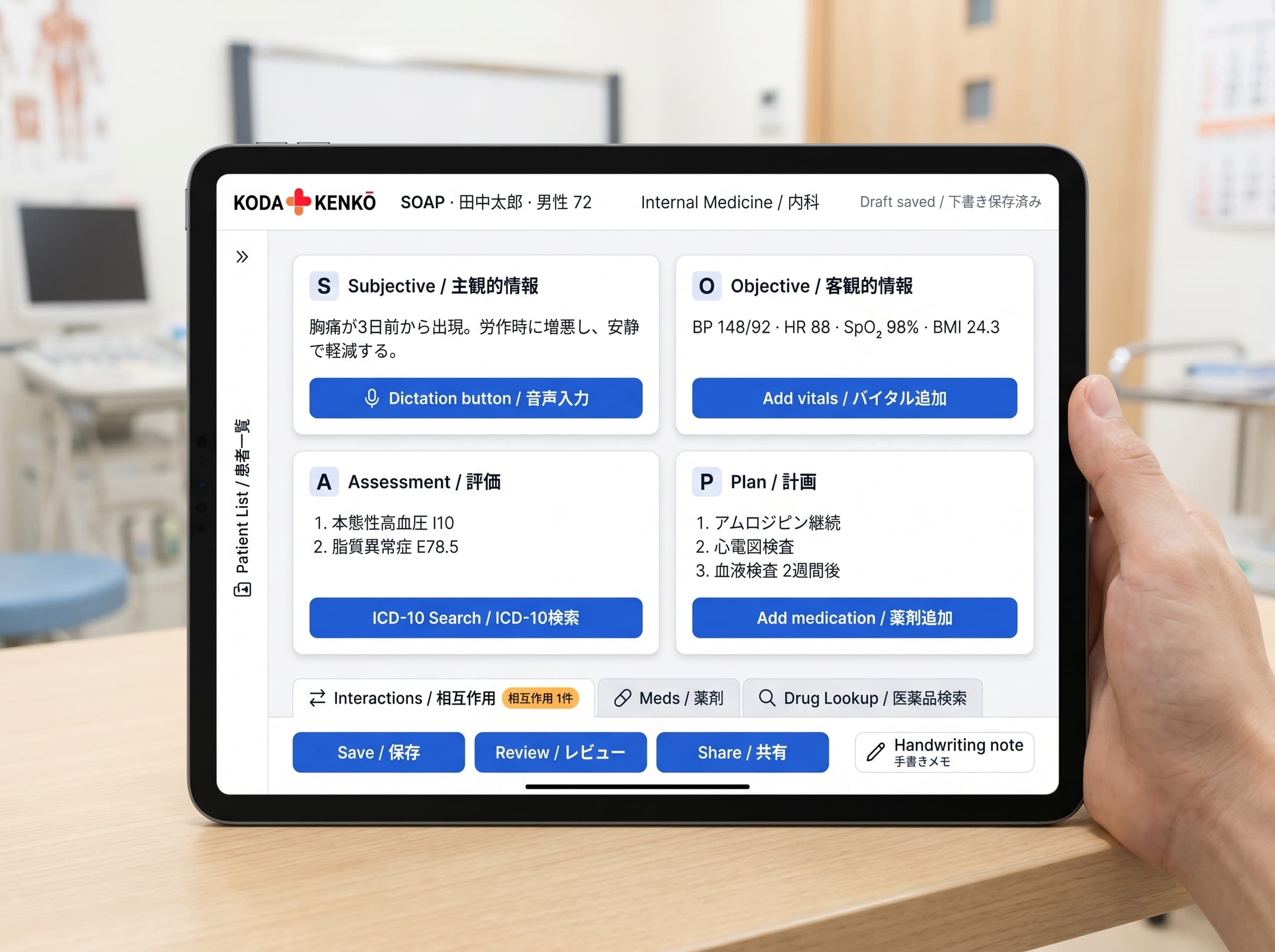
Medical SOAP
Japanese clinical documentation, reviewed and finalised by the clinician.
See product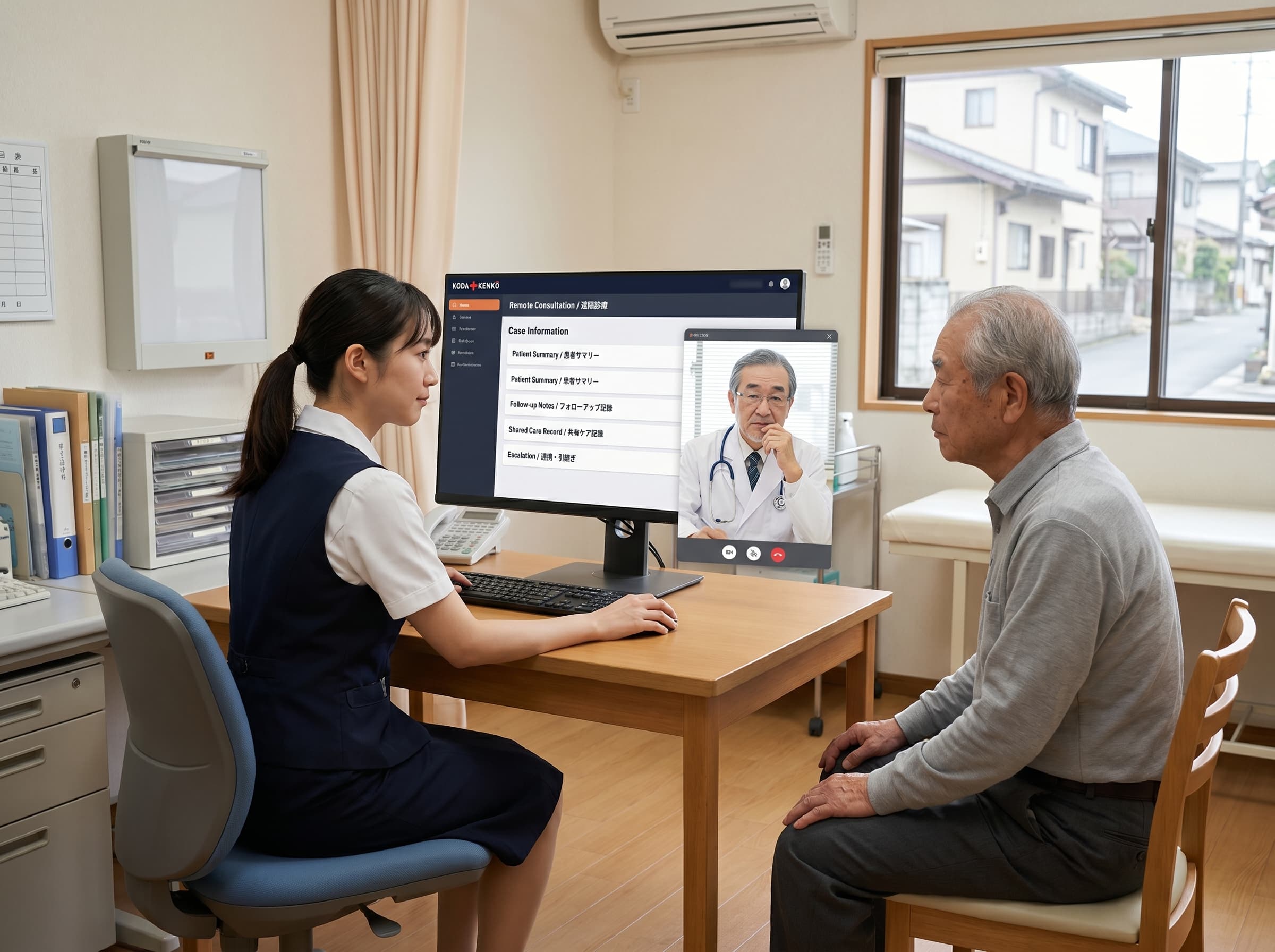
Telemedicine Bridge
Case preparation, shared bilingual record, and asynchronous follow-up — bridging local clinics to remote specialists.
See product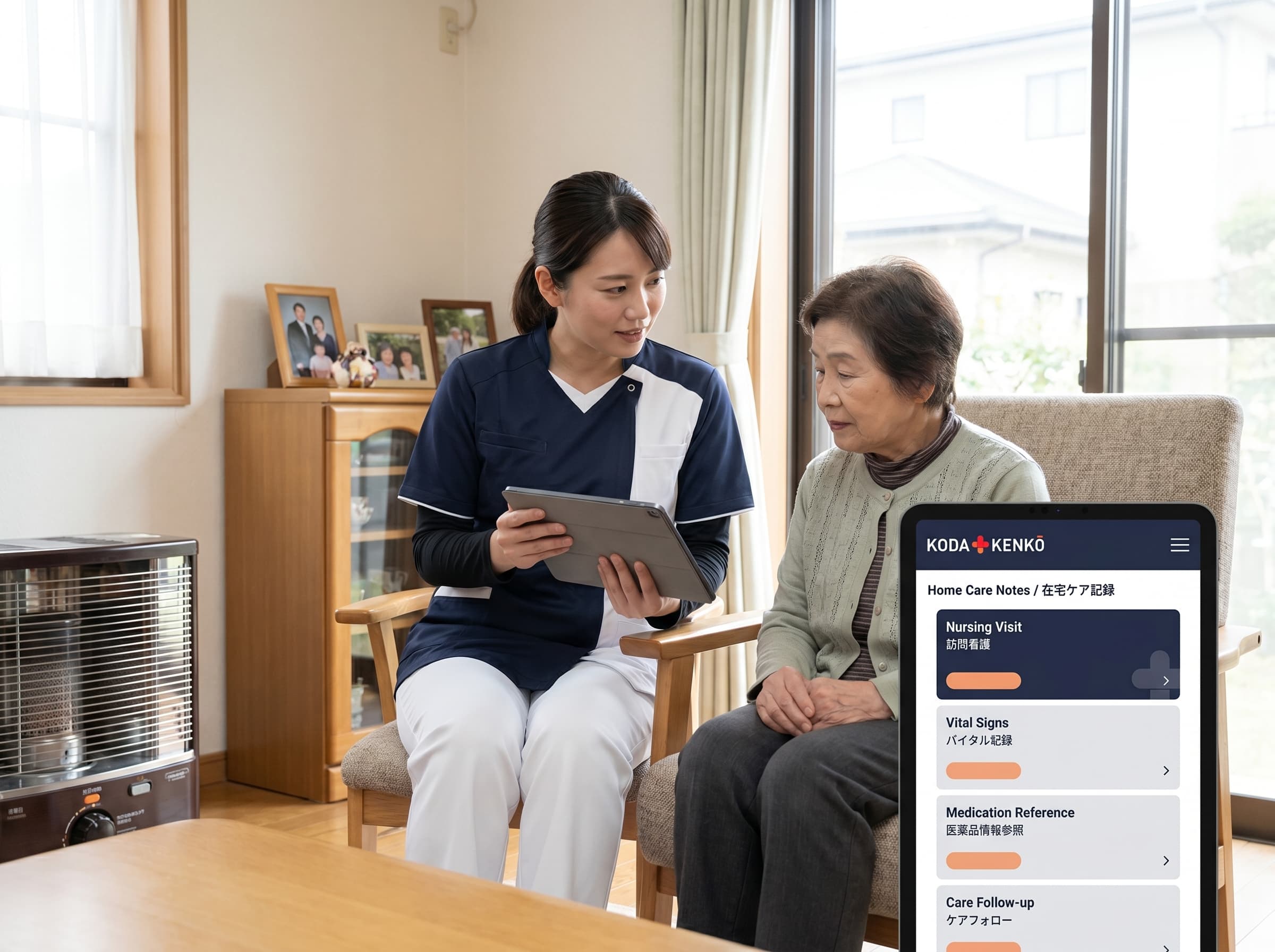
Home Care & Nursing
Visit notes, vital signs, and medication reference for visiting nurses.
See product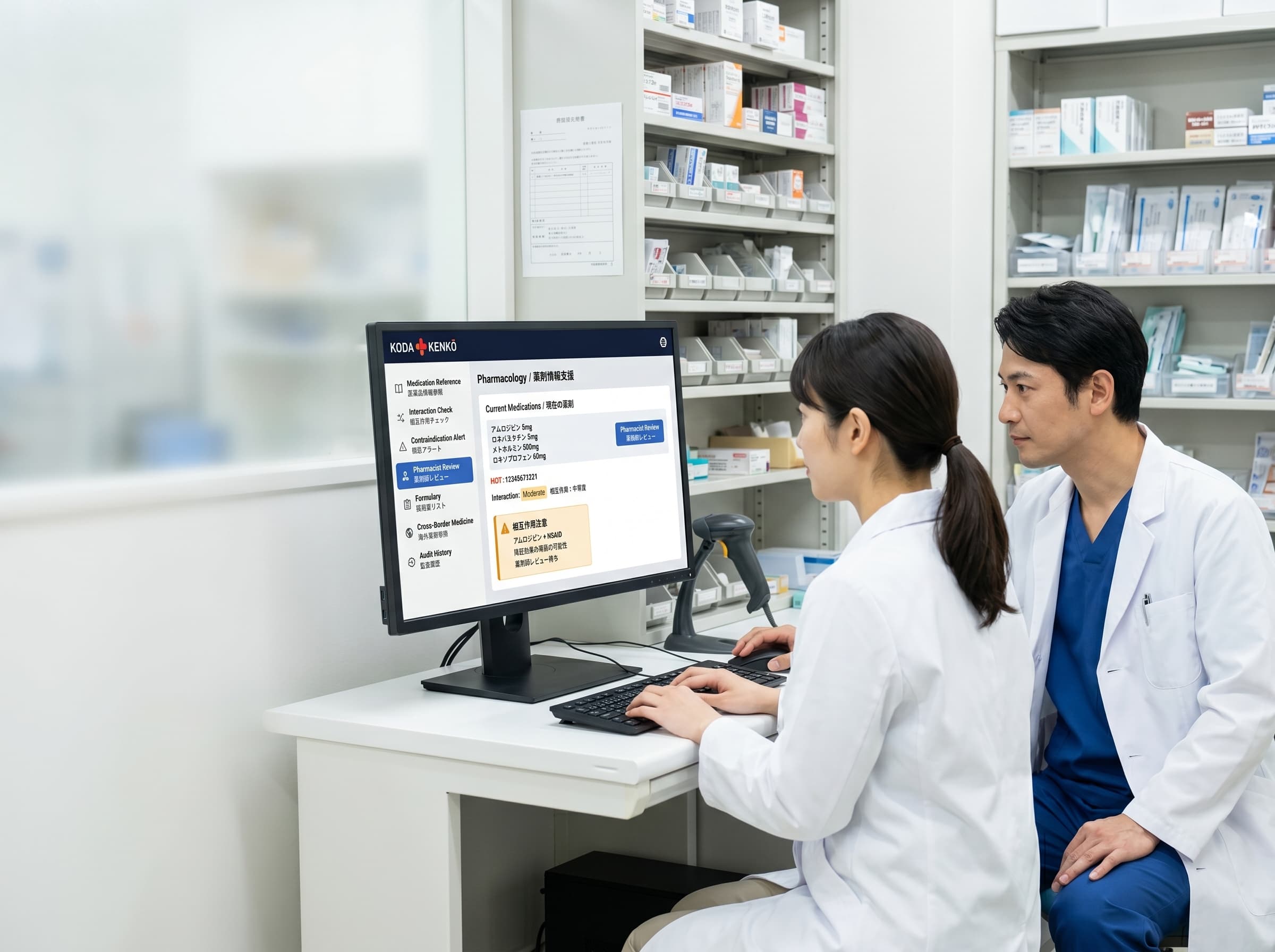
Pharmacology
HOT-code-native drug master, interactions, and pharmacist review — with cross-border medication reference.
See product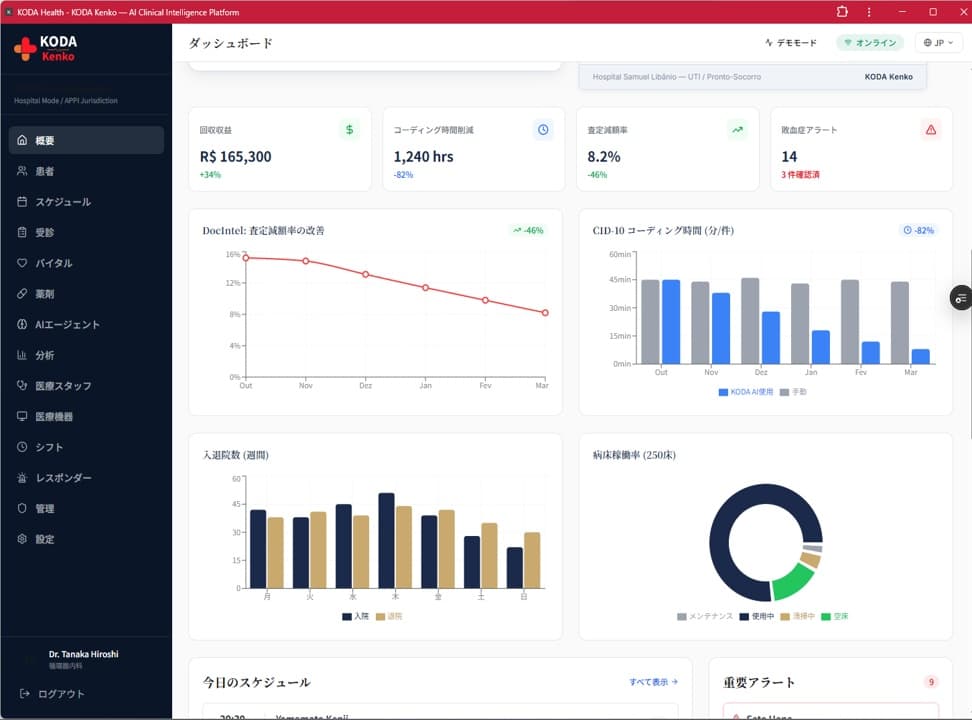
Hospital Operations
Bed occupancy, equipment booking, shift rosters, and clinical team coordination — one operational view across departments.
See product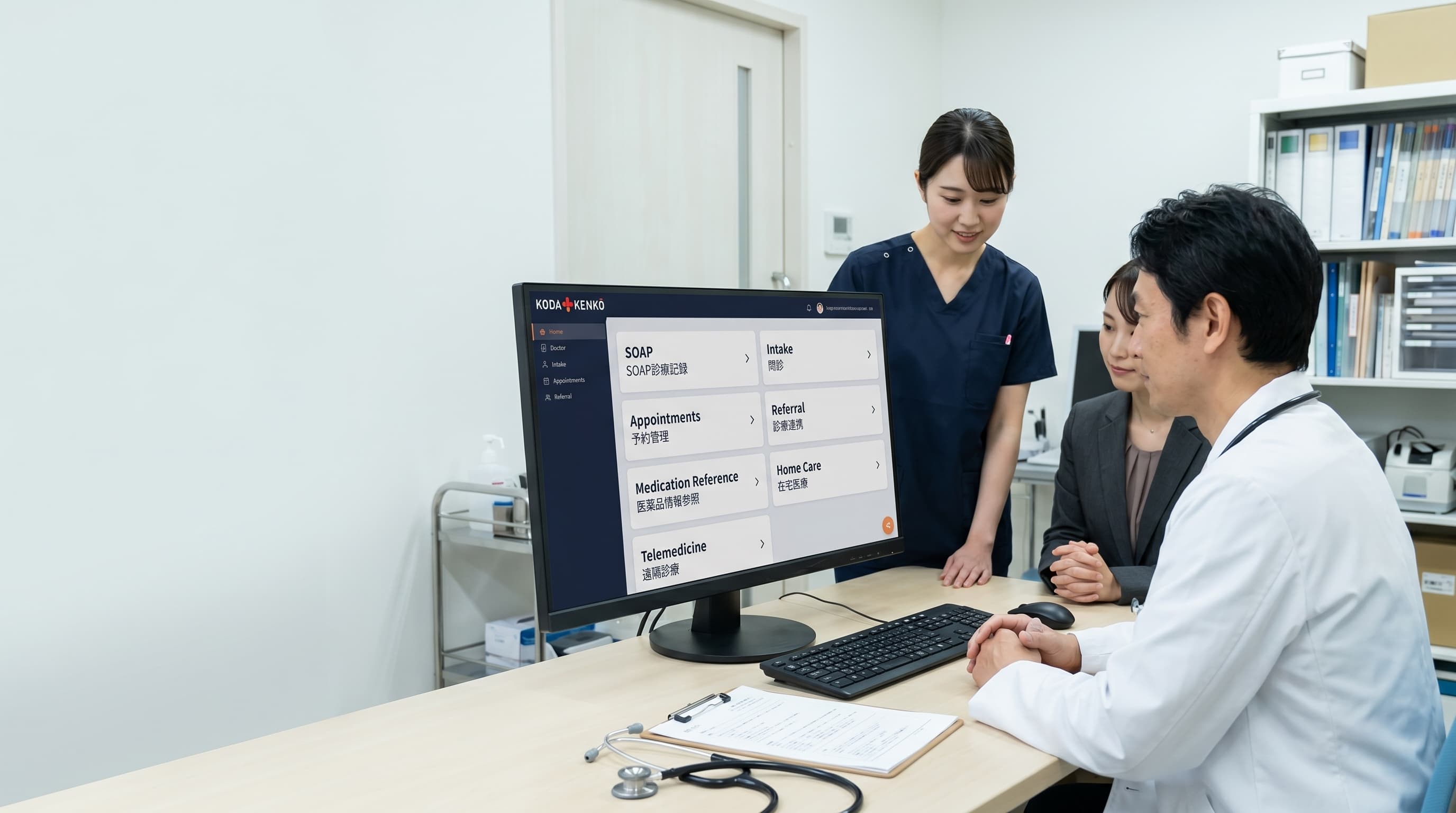
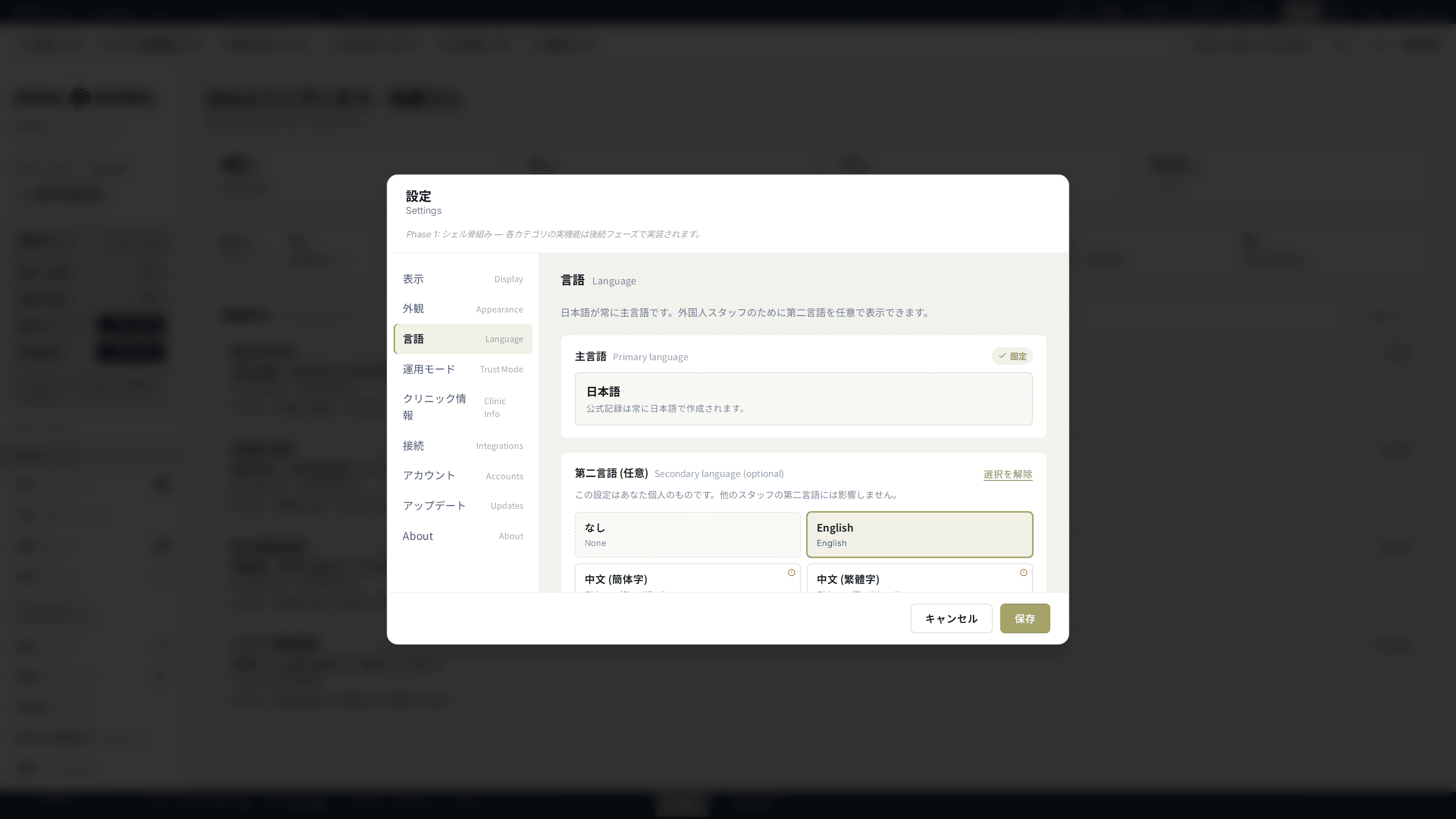
Bilingual Japanese records
English, Portuguese, Chinese, Vietnamese, Tagalog, Nepali, and other major Asian languages — inbound patients understood and documented in Japanese for the clinical record. Dictation that handles Kansai, Tōhoku, Kyūshū, and Hokkaido regional speech. The foreign-patient flow most clinics still handle manually, built into the workflow.
Clerk-side AI
Built for the front desk and medical office, not just the doctor’s voice. Patient intake, referral letters, claims preparation, and document triage — drafted by AI, approved by the clerk.
Cross-model verification
Every AI-drafted artefact is reviewed by a second model before it reaches the human reviewer — schema validation, source grounding, factual consistency, and hallucination detection. Models change. Vendors change. The verifier layer keeps your records safe across all of it. Built on KoLo OS.
Clinician-in-the-loop by default
Every clinical output reviewed and approved by a human professional. The reviewer is recorded. The timestamp is recorded. The artefact before and after is recorded. The approval is a load-bearing part of the workflow, not a checkbox.
HOT-code-native pharmacology
Japanese drug master built on HOT codes — composition, dosage forms, interactions, contraindications, indications. Pharmacist review workflow with audit trail. Cross-border medication reference for foreign-patient continuity.
Built for Japan.
KODA KENKŌ is designed from Japanese medical practice, not adapted from foreign healthcare software.
Its SOAP structure follows the clinical logic Japanese professionals already use: 主観的情報 · 客観的情報 · 評価 · 計画. Dictation supports regional Japanese speech patterns, including Kansai, Tōhoku, Kyūshū, and Hokkaido, while multilingual intake helps clinics support foreign patients and foreign workers in English, Portuguese, Chinese, Vietnamese, Tagalog, Nepali, and other major Asian languages.
Founders
Built by clinicians
and engineers, together.
Carlos Mundim, MSc
Co-founder & Chief Architect
Creator of the KoLo system and the architecture behind KODA KENKŌ. Building distributed-optimization and neuro-inspired systems since 2008 — now architecting advanced agentic AI: persistent memory, multi-agent coordination, and governed autonomy as first-class runtime primitives.
Jeanette Dennisson, PhD
Co-founder & Chief Science Officer
Professor at St. Marianna University School of Medicine; research specialist in speech recognition and AI for spoken language, English-medium medical education (EMI/CLIL), and medical communication. She trains and evaluates AI agents on medical taxonomy, clinical ontology, and spoken-language understanding.
Start with one product.
20 minutes with engineering.
We open the platform on your real operational pain point — intake, SOAP, medication reference, home-care notes, telehealth, hospital operations — and run it end-to-end. No deck.
Pricing scaled to clinic size — from single-provider clinics to university hospitals.